

Volodymyr Betz (1834-1894) is a world-renowned neurobiologist, anatomist and histologist, professor of the St. Volodymyr University of Kyiv (now Taras Shevchenko National University). He is known for the discovery of giant pyramidal neurons of primary motor cortex which later were named Betz cells, and is the most famous Ukrainian neuroscientist.
In the north of Ukraine, on the left bank of the picturesque Desna river, there is a small but ancient town Oster. The first written record of it dates from year 1098, although people lived here much earlier: archaeological research revealed a settlement of the Bronze Age (2000 BC) at the territory of Oster and in the surrounding area. At the time of Kyivan Rus (X-XIII centuries) the city had an extremely strategic value as the northern outpost of contemporary Ukrainian state. The development of Oster contributed to its location at the crossroads of important trade routes from northern principalities to Byzantium and to the capital city of Kyiv. During its long history Oster had experienced times of prosperity, and also difficult and even tragic periods. Today it is an ordinary Ukrainian provincial town in Kozelets district, Chernihiv region, living quiet and peaceful, like most towns distant from large cities and agglomerations. Calm, relaxed and somewhat slow pace of life in Oster largely contributes to remarkably beautiful nature that attracts landscape artists, filmmakers and other people of art.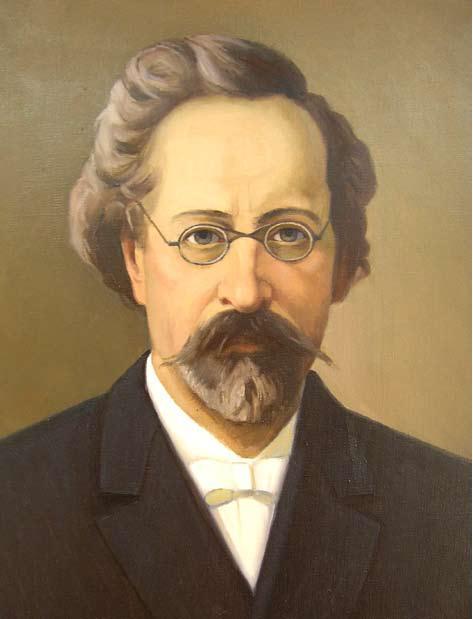
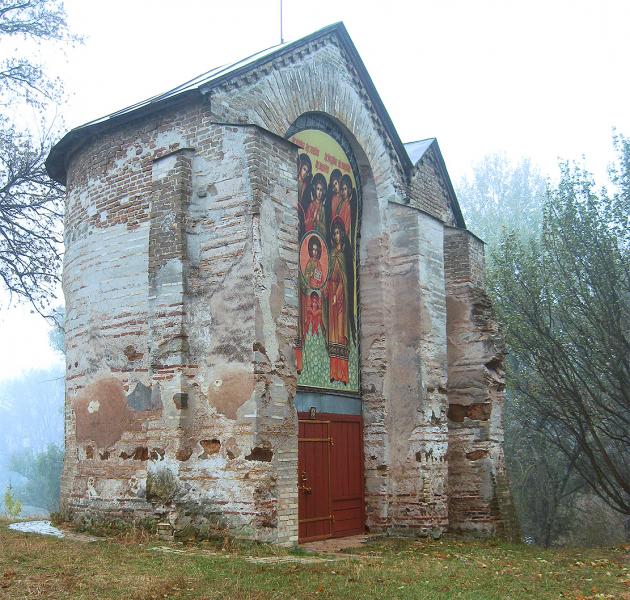
Church of St. Michael (Oster) - St. George temple. The monument of ancient ukrainian architecture of XI century (Wikimapia)

Desna river near the town of Oster (Wikimedia Commons)

Desna river near the town of Oster (Wikimedia Commons)
Betz significantly expanded the scope of his scientific interests: he started a research on osteology and studied the ultrastructure of the adrenal glands. The study of these glands has been described by him in 1864 in the paper entitled "A few remarks to the microscopic structure of the adrenal glands." It should be emphasized that these pioneering works provided Betz with unquestioned authority as a highly professional specialist in anatomy and histology among European scientists of the time. Betz not only possessed perfect skills of cytohistologic and microscopic techniques, but also improved them constantly and successfully, adding to them something new and progressive. He managed to make a kind of synthesis between anatomy and histology, and, in the approach to the study of brain, the scientist combined the concepts and methodologies of macroanatomy with the talent of microanatomist and histologist. In fact, this combination of research techniques had no analogues before V. Betz, and thus he created a doctrine of cyto- and myeloarchitectonics, unique by its theoretical and practical values. This doctrine defined the real picture of nerve cells called neurons. Volodymyr Betz was the first in the world to study the cytoarchitectonics of the cortex, linking its structure with functions.
The success of Volodymyr Betz contributed to the fact that he effectively combined talents of scrupulous practitioner and high-erudite theorist. This allowed him to develop new and original methods of fixing the brain tissue, its dyeing and obtaining qualitative histological sections. V. Betz’s works, especially "A new way to study human central nervous system" (1870), revealed to the scientific world a technique of making cuts and getting microscopic preparations of the brain, herewith adding something progressive and new at every stage of the research.
Betz believed his histological science could aid in explaining neurological diseases, and thus he approached clinical medicine using science: “It is up to the scientists and psychiatrists to research more thoroughly these centers in the brain and especially anteriorly… . This could possibly throw light on the sudden occurrence of temporary paralysis of cerebral origin; on eclampsia of pregnancy; or epileptic convulsions, hysterical laughter, and finally it could, in a great area, explain the appearance of partial or total aphasia”.
Betz's revolutionary methods of fixation and staining were the result of his motivation to improve histological technique and to exploit the latest microscope technology. As described in his 1873 paper Die Untersuchungsmethode des Centralnervensystems beim Menschen, many of his methods were enormously complicated. Betz significantly improved Reil's method of brain tissue fixation with ethanol by adding ether and chloroform, potassium bichromate, and iodine. He established certain fixation solutions and methods for fixing every specific brain structure.
Betz's method allowed him to cut extremely thin brain sections. He had specific instructions for cutting and invented a system that minimized friction and allowed tissue to be cut smoothly. A perfectly hardened brain permits very large and thin sections to be made. For these purposes Betz invented a special guillotine-like cutting machine that yielded excellent brain sections.
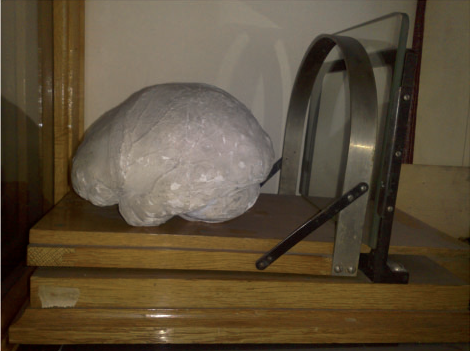
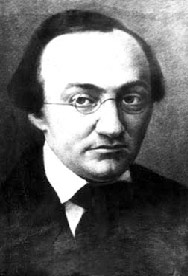 Besides the nerve tissue preparations for microscopic studies, Betz has worked a lot on the manufacturing of plaster casts of the brain surface macropreparations. This is how he described it in his work: “…We should cover the hemisphere with a dense solution of burnt gypsum, alternately in different places, till it covers the entire surface of the brain. We must try to make the plaster coating uniform, for the mold can be easily removed from the spherical surface of the brain in separate parts, and then the parts could be connected again and greased with oil. Subsequently, the obtained mold is filled with plaster, and after its hardening, the mold has to be removed. The resulting plaster cast is an exact copy of a hemisphere, imprint of which was made." The plaster casts method allowed V. Betz to get a detailed picture of the topography of the brain hemispheres convolutions. The data on the structure of the cerebral hemispheres, obtained using this method, were published by V. Betz in a number of works, and the most prospective among them was "Anatomy of the surface of the human brain" (1883).
Professor Olexandr P. Walter.

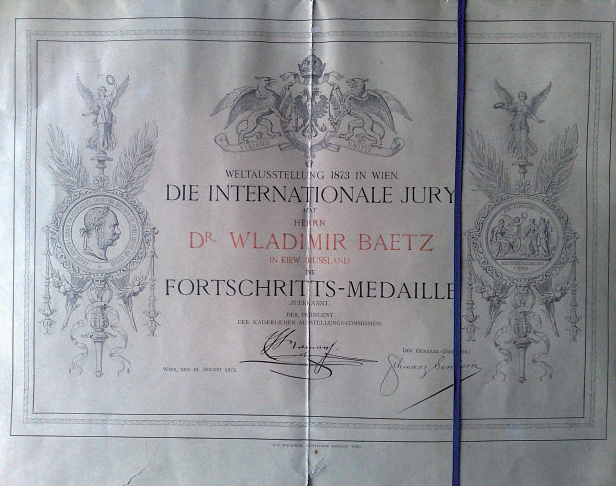
Volodymyr Betz created a massive collection of 8941 brain and spinal cord specimens, with samples of healthy and mentally ill humans, infants, monkeys, dogs and rats. He received many honours and awards for his work, including medals at the All-Russian Manufacturing Exhibition in 1870 in St Petersburg and a “Fortschritts Medaille”at the Vienna World Exhibition in 1873, where the collection was valued at 30000 Austrian guilders or 2 kg of gold. Being a true patriot of his native country, V. Betz refused the offer of Professor V. Benedikt to sell the collection of histological preparations. He presented this collection to the Department of Human Anatomy of Bogomolets National Medical University, where it is still kept together with a proof and, unfortunately, unique copy of “Atlas of human brain” (1890), more about which will be said below.
In 1874 Volodymyr Betz described the giant pyramidal neurons in the primary motor cortex, which later were named Betz cells.
 It was the most significant contribution of Betz to the world neuroscience.
Betz's most significant contribution was to connect cerebral organization and function with specific, unique histological evidence. ‘The sulcus of Rolando divides the cerebral surface into two parts … an anterior in which the large pyramidal nerve cells predominate.’ ‘They are predominantly in the fourth cortical layer and are from 0.05–0.06 mm wide and from 0.04–0.12 mm long … . Undoubtedly these cells have all the attributes of so-called “motor cells” and definitely continue as cerebral nerve fibres’ (Betz, 1874). Betz wrote that he discovered these cells, which he called ‘giant pyramids’, in Meynert's fourth cortical layer (i.e. next to the deepest layer) of the precentral gyrus. Since that time the layers have been refined, and today the Betz cells are defined as being found in the fifth cortical layer. As well as in the human precentral gyrus, Betz found these cells in the same location in dogs, chimpanzees, baboons, and other primates. Although Volodymyr Betz is known primarily as a neuroanatomist, it should be emphasized that he was a scientist of a much broader interests and made a significant contribution to various areas of biomedical science. In particular, V. Betz thoroughly studied the bone tissue, especially its growth and development in embryonic and postembryonic periods. His most known works on this topic are "Cranial Sutures" (1879) and "The Morphology of Osteogenesis" (1887).
 Betz has also made significant achievements in the field of sanitary medicine and epidemiology. Particularly, he participated actively in organization, preparation and conduction of anticholeraic measures during the epidemic of this disease in 1892, what was described by him in details in the brochure "Essay on Measures at the 1892 Cholera Epidemic on the South Western Railways."
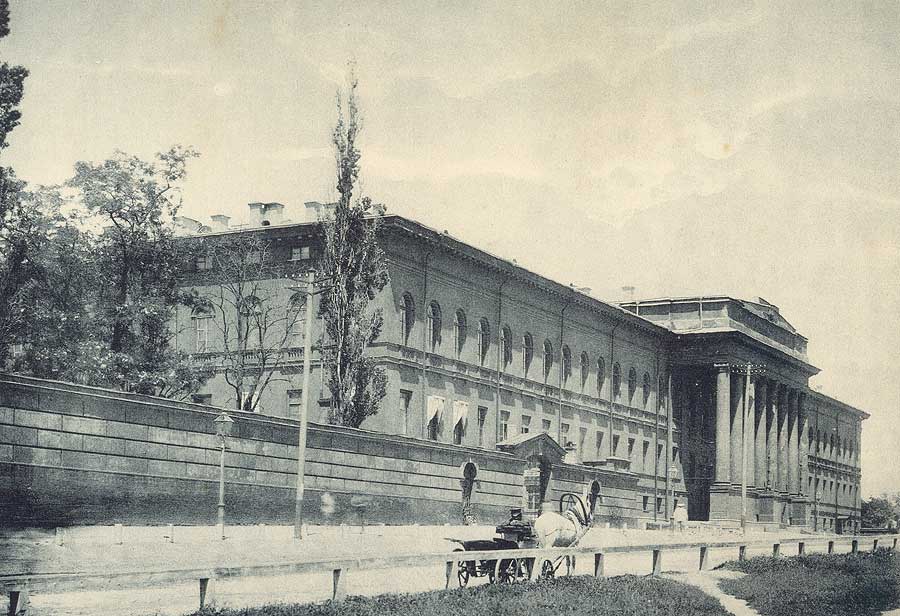
As a member of the Kyiv City Council, Volodymyr Betz supervised the antiepidemic measures in Kyiv, controlled the quality of drinking water in Kyiv, security of its citizens, general sanitary status and more. Talking about Volodymyr Betz, we should not miss his one more "offspring", the Anatomical Theatre. This separate educational institution at the university served for teaching and studying all disciplines of the medical faculty: normal anatomy, pathological anatomy, surgical anatomy of forensic medicine, normal histology, and pathological histology of common diseases. Construction of the complex, designed specifically for the Department of Anatomy, was initiated by V. Betz’s teacher, Professor Olexandr Walter. Creating conditions relevant to European requirements for complex anatomy studies was defined as the most important task in the educational process. In 1851-1853 the building of the Anatomical Theatre was constructed (now the Ukrainian National Museum of Medicine is situated there). As V. Betz, the successor of Professor Walter, said, it was a palace of science, which capabilities exceeded most of analogous European institutions. The Anatomical Theatre was supervised by V. Betz as Head of the Normal Anatomy Department at the St. Volodymyr University. The scientist gave a lot of attention to the development and modernization of the Theatre, as well as of the Department of Anatomy. Beyond any doubt, Kyiv Anatomical Theatre was one of the best institutions of the kind in Europe and worldwide. This high reputation was gained largely due to the enthusiasm, industriousness and self-sacrifice of Volodymyr Betz. We know that he has done a great work for its technical improvement, achieved acquisition of a significant amount of various equipment, scientific and medical apparatuses and so on. Betz presented to the Theatre an exceedingly valuable library of about 300 books of 17-19 centuries. These were unique editions on different fields of anatomy, physiology, histology, morphology, medicine, and also on chemistry, physics, zoology, anthropology, history, archeology, ethnography, published in Latin, French, German, English, Russian and other languages. But obviously, even more valuable treasure he gave to his alma mater: histological preparations of central nervous system of humans and some other animal species, sections of the brain and spinal cord, plaster casts of the brain, an anthropological collection of skulls, a set of images of the brain on gelatin plates and so on. Moreover, in 1884 Volodymyr Bets published a detailed description, “Anatomical Theatre of the St. Volodymyr University, 1840-1884", thanks to which we now have invaluable information on the history of its construction and functioning.
St Volodymyr University Kyiv
Betz's most significant contribution was to connect cerebral organization and function with specific, unique histological evidence. ‘The sulcus of Rolando divides the cerebral surface into two parts … an anterior in which the large pyramidal nerve cells predominate.’ ‘They are predominantly in the fourth cortical layer and are from 0.05–0.06 mm wide and from 0.04–0.12 mm long … . Undoubtedly these cells have all the attributes of so-called “motor cells” and definitely continue as cerebral nerve fibres’ (Betz, 1874). Betz wrote that he discovered these cells, which he called ‘giant pyramids’, in Meynert's fourth cortical layer (i.e. next to the deepest layer) of the precentral gyrus. Since that time the layers have been refined, and today the Betz cells are defined as being found in the fifth cortical layer. As well as in the human precentral gyrus, Betz found these cells in the same location in dogs, chimpanzees, baboons, and other primates. Although Volodymyr Betz is known primarily as a neuroanatomist, it should be emphasized that he was a scientist of a much broader interests and made a significant contribution to various areas of biomedical science. In particular, V. Betz thoroughly studied the bone tissue, especially its growth and development in embryonic and postembryonic periods. His most known works on this topic are "Cranial Sutures" (1879) and "The Morphology of Osteogenesis" (1887).
A perfectly hardened brain permits very large and thin sections to be made. I have preparations of the whole pons Varolii with the corpora quadrigemina, which are thin enough to be examined with immersion lenses, and I have lately obtained complete transverse sections through the whole of the hemisphere. Very thin sections are obtained from the cord and medulla oblongata, e.g. of one twelfth or one twentieth of a millimeter in thickness.’ (Betz, 1873). For these purposes Betz invented a special guillotine-like cutting machine that yielded excellent brain sections.
As a member of the Kyiv City Council, Volodymyr Betz supervised the antiepidemic measures in Kyiv, controlled the quality of drinking water in Kyiv, security of its citizens, general sanitary status and more. Talking about Volodymyr Betz, we should not miss his one more "offspring", the Anatomical Theatre. This separate educational institution at the university served for teaching and studying all disciplines of the medical faculty: normal anatomy, pathological anatomy, surgical anatomy of forensic medicine, normal histology, and pathological histology of common diseases. Construction of the complex, designed specifically for the Department of Anatomy, was initiated by V. Betz’s teacher, Professor Olexandr Walter. Creating conditions relevant to European requirements for complex anatomy studies was defined as the most important task in the educational process. In 1851-1853 the building of the Anatomical Theatre was constructed (now the Ukrainian National Museum of Medicine is situated there). As V. Betz, the successor of Professor Walter, said, it was a palace of science, which capabilities exceeded most of analogous European institutions. The Anatomical Theatre was supervised by V. Betz as Head of the Normal Anatomy Department at the St. Volodymyr University. The scientist gave a lot of attention to the development and modernization of the Theatre, as well as of the Department of Anatomy. Beyond any doubt, Kyiv Anatomical Theatre was one of the best institutions of the kind in Europe and worldwide. This high reputation was gained largely due to the enthusiasm, industriousness and self-sacrifice of Volodymyr Betz. We know that he has done a great work for its technical improvement, achieved acquisition of a significant amount of various equipment, scientific and medical apparatuses and so on. Betz presented to the Theatre an exceedingly valuable library of about 300 books of 17-19 centuries. These were unique editions on different fields of anatomy, physiology, histology, morphology, medicine, and also on chemistry, physics, zoology, anthropology, history, archeology, ethnography, published in Latin, French, German, English, Russian and other languages. But obviously, even more valuable treasure he gave to his alma mater: histological preparations of central nervous system of humans and some other animal species, sections of the brain and spinal cord, plaster casts of the brain, an anthropological collection of skulls, a set of images of the brain on gelatin plates and so on. Moreover, in 1884 Volodymyr Bets published a detailed description, “Anatomical Theatre of the St. Volodymyr University, 1840-1884", thanks to which we now have invaluable information on the history of its construction and functioning.
Volodymyr Betz was an incredibly multidimensional personality. He never limited to one certain narrow scientific problem. Besides being a researcher, this was a highly talented lecturer and an excellent teacher. His lectures were attended not only by his students, but also by experienced scientists and doctors, some of which came from other cities. Moreover, V. Betz worked intensively in the field of enlightenment and popularization of science. For example, it is nown that in 1860-61 V. Betz, together with Nikolai Leskov as a co-author, worked on a brochure about the development of hygiene legislation in England. In particular, in this brochure was emphasized the fact that in this country has been statistically proven a correlation between morbidity and mortality indicators and the level of infrastructure and sanitary conditions in settlements, and general living standards.
In 1864-67 Volodymyr Betz taught anatomy and histology at the university, in 1868 he was appointed as Extraordinary Professor, and in 1870 became a Full Professor of anatomy. Professor Betz prepared his lectures with a lot of work, knowledge and professionalism, but also demanded the same from his students. All future doctors knew how difficult it was to pass the anatomy exam to this teacher. A brilliant expert of his subject, he was digging deeply and liked to ask insidious questions. But despite some austerity, students loved and respected Volodymyr Betz.
However, the scientist had to be cautious.
 The University administration treated V. Betz with suspicion, considered him a liberal, besides the scientist often conducted public lectures for the benefit of needy students and helped them financially (that was not typical for most others). But V. Betz wasn’t scared neither of the persecution of "undesirable" workers and students, nor even of numerous arrests that were made by Russian imperial authorities in Kyiv University in the 1870s. And while the "polite" University professors, wherever possible, were trying to express their loyalty to the Tsar government, Volodymyr Betz continued to teach in his special manner, filling his lectures with his freedom-loving outlook on life, social events, and on the person’s place in nature and society.
Another important achievement of V. Betz is that he was one of the pioneers of the photography in Kyiv.
The University administration treated V. Betz with suspicion, considered him a liberal, besides the scientist often conducted public lectures for the benefit of needy students and helped them financially (that was not typical for most others). But V. Betz wasn’t scared neither of the persecution of "undesirable" workers and students, nor even of numerous arrests that were made by Russian imperial authorities in Kyiv University in the 1870s. And while the "polite" University professors, wherever possible, were trying to express their loyalty to the Tsar government, Volodymyr Betz continued to teach in his special manner, filling his lectures with his freedom-loving outlook on life, social events, and on the person’s place in nature and society.
Another important achievement of V. Betz is that he was one of the pioneers of the photography in Kyiv.
He was motivated to engage seriously in photography mostly because of the desire to publish images of his histological preparations in high quality. And this is how the story began. In 1872, in Leipzig, at the Congress of naturalists and physicians, Professor K. Ludwig examined V. Betz’s collection and offered to print an atlas with drawings of his preparations for funds of the Dresden Academy of Sciences, but the Ukrainian scientist refused because he wanted to publish the atlas at his homeland. In Kyiv at the time there was neither equipment nor professionals who could provide the printing of the illustrated edition of suitable quality. And Volodymyr Betz practically started from scratch. On the advice of Professor Broca, he studied photography and photoengraving in Vienna, practicing to make photos of his histological preparations. In particular, V. Betz received permissions of the Austrian Defense Minister and of the administration of the Vienna Geographic Institute for a direct acquaintance with this institution and with various modern technologies of manufacturing drawings and photographs. The scientist has mastered the four ways of making clichés and images for printing: photographic, photolithographic, photocyncographic, and heliographic (the latter occupied the top spot at the Vienna Geographical Institute). Soon, namely in the 1873/1874 academic year, in Kyiv, Volodymyr Betz has made phototypic clichés for his atlas by Merkel phototypesetting. However, at this stage, he faced technical problems again: Kyiv lithography masters could not establish a high-quality printing of images with these clichés, but only spoiled them. Betz tried to find a solution to this problem in St. Petersburg, where he went in search of a potential publisher, but to no avail. Furthermore, the scientist needed considerable financial resources for all this complex publishing process. He requested funding at the Academy of Sciences and at the Ministry of Education, but received only rejections and come-offs. Maybe someone would give up, but not Volodymyr Betz. He did not retreat and decided to print his tables at his own. He bought lithographic tools, stones and other necessary equipment at his own expense. After getting a permission of the University Council, he placed the printing equipment in the Anatomical Theatre and began to study different ways of printing, focusing on phototypesetting that was new at that time.
 According to the Betz’s plan, the first part of the atlas had to represent the anatomical surface of the brain. For this he had to make up to 200 photos of preparations and circa 150 clichés. The work lasted more than three years, and a copy of the atlas was published before June 1879. In August of that year a French Professor Paul Pierre Broca visited Kyiv to review the Betz’s preparations. Having returned to Paris, he sent to the Ukrainian scientist his findings about the anatomy of the olfactory lobe, which is hardly developed in humans, but makes a significant part of the cerebral cortex in animals. Betz became fascinated with the idea either to prove or to disprove the connection of the rudimentary olfactory lobe with the other mass of convolutions. The titanic work of Volodymyr Betz (5000 (!) new preparations were made during this study) allowed the researcher to answer the question affirmatively and to set 11 types of anatomical structures of the brain convolutions. Volodymyr Betz then concluded that the anatomy of convolutions should be primarily considered not by morphological point of view, as it was before, but by the histological one.
 These studies he published in 1881.
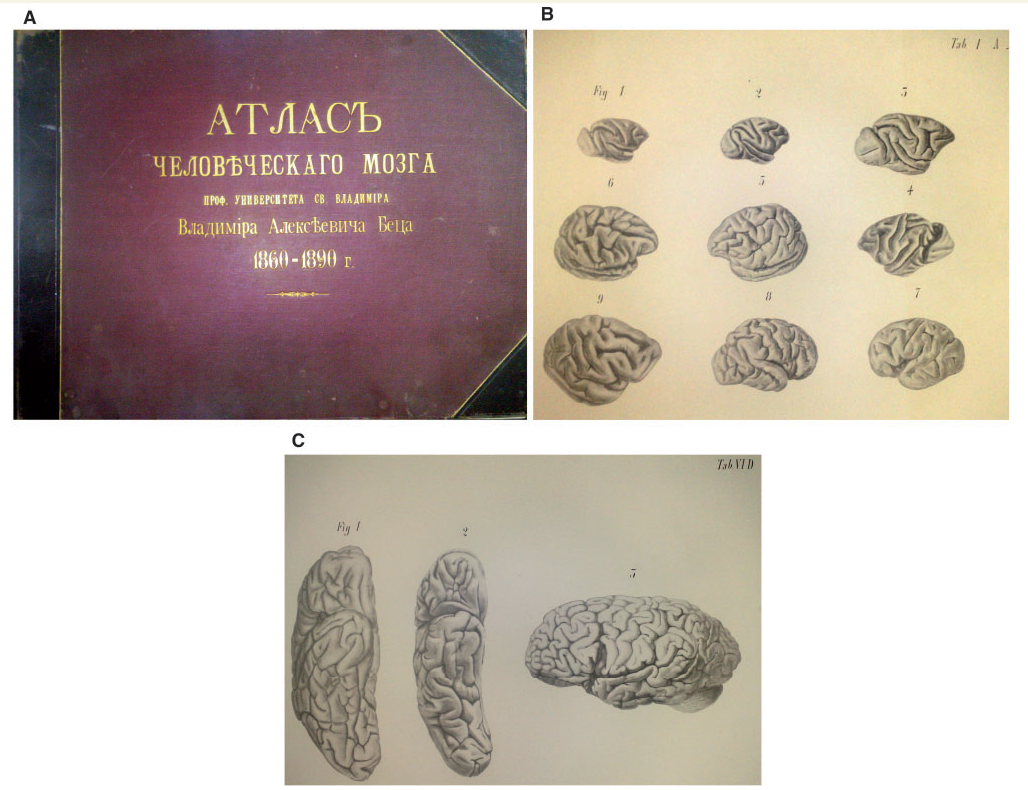
At that time, the scientist again suspended his work on publishing the atlas. He wanted to complement the ready 30 tables with new, clearly reflecting the results of these studies. But unfortunately, the study that took so many years of dedicated work, effort and talent, was never published. Only one printed copy of the Atlas (“Atlas of the Human Brain by the Professor of St. Volodymyr University V.O. Betz”, 1860-1890) is known and is now stored at the Department of Anatomy of the O. Bohomolets National Medical University in Kyiv. So, all the difficulties and obstacles in preparing this atlas, desperately overcome by Volodymyr Betz,
 also had some positive impact.
Apparently, without them we could not talk about Betz as one of the prominent activists of photography and even printing in Kyiv, the founder of the first Kyiv phototypesetting lab. Volodymyr Betz participated directly in the opening of the photographic section at the Kyiv department of the Imperator’s Russian Technical Society and headed it for a long time. At the 4th regular meeting of the Kyiv Society of Naturalists on April 24, 1882, V. Betz made a report about momentary photographic methods. He studied, organized and technically equipped the photolab and typography at such a high professional and qualitative rate that received orders, including from abroad, for manufacturing clichés and printing illustrated books. Actually, speaking of Volodymyr Betz’s publishing activity, we should stress that he participated actively in publication not only of biomedical issues, but also of works on history, ethnography, archeology. A special place among the works published by Volodymyr Betz takes a book written jointly with Ukrainian historian Volodymyr Antonovich, "Historical Figures of the South-West Russia in Biographies and Portraits." This book was aimed to familiarize a broad audience with the biographies of prominent Ukrainian figures, especially Hetmans. The basis of the illustrated material was made of portraits from the collection of a renowned collector of Ukrainian antiquities, V.V. Tarnovsky. The publication of this book could not appeal to the imperial Russian authorities that ruled Kyiv at that time. Volodymyr Betz was accused of "Malorossian separatism" and eventually dismissed from the post of the Head of department. The fact that Volodymyr took a direct part in publishing of this project does not seem strange. His interest in history can be clearly seen even in purely biological papers and lectures, in which he had always paid much attention to the historical aspect. Betz’s passion for Ukraine's past was also contributed to the fact that he belonged to the descendants of the Cossack officers of Hetman age, among which the memory of a glorious past cherished. Volodymyr died on October 12, 1894 (Sept. 30 Old Style), at 4 o'clock in the morning. But before, he also was periodically ill. Frequent catarrhal diseases might be contributed to the fact that it was always cold in the Anatomical Theater: Betz even had to put a fur coat on his shoulders while lecturing. The tomb of the great scientist is located in the picturesque and secluded corner of Vydubychi Monastery in a few steps from the Church of Archangel Michael – it was the last will of Betz.
REFERENCES:
1.Назаренко, Д. ( 2012) Володимир Бец: у медицині й поза нею. Скарбниця української культури. Збірник наукових праць.– Вип. 14. Чернігівський історичний музей імені В. В. Тарновського, Чернігівське відділення Інституту української археографії та джерелознавства імені М. С. Грушевського НАН України, Чернігівська обласна організація Національної спілки краєзнавців України; – Чернігів – 251-27.
2. Kushchayev, Sergiy V., et al. "The discovery of the pyramidal neurons: Vladimir Betz and a new era of neuroscience." Brain 135.1 (2012): 285-300.
3. http://anatom.ua/memoria/betz/
4. http://www.nmu.edu.ua/eng/kaf7-1.php
5. Moskalenko, V. F., Cherkasov, V. G., & Vasilenko, D. A. (2010). The world-renowned Ukrainian neuroanatomist Prof. Vladimir A. Bets. Neurophysiology, 42, 3-9. http://link.springer.com/article/10.1007%2Fs11062-010-9124-x
Certificate announcing the ‘Fortschritts Medaille’ presented to Betz at the Vienna World Exposition of 1873. Photograph courtesy of the Vladimir Betz Museum at the Department of Anatomy Bogomolets National Medical University, Kiev, Ukraine.
He was motivated to engage seriously in photography mostly because of the desire to publish images of his histological preparations in high quality. And this is how the story began. In 1872, in Leipzig, at the Congress of naturalists and physicians, Professor K. Ludwig examined V. Betz’s collection and offered to print an atlas with drawings of his preparations for funds of the Dresden Academy of Sciences, but the Ukrainian scientist refused because he wanted to publish the atlas at his homeland. In Kyiv at the time there was neither equipment nor professionals who could provide the printing of the illustrated edition of suitable quality. And Volodymyr Betz practically started from scratch. On the advice of Professor Broca, he studied photography and photoengraving in Vienna, practicing to make photos of his histological preparations. In particular, V. Betz received permissions of the Austrian Defense Minister and of the administration of the Vienna Geographic Institute for a direct acquaintance with this institution and with various modern technologies of manufacturing drawings and photographs. The scientist has mastered the four ways of making clichés and images for printing: photographic, photolithographic, photocyncographic, and heliographic (the latter occupied the top spot at the Vienna Geographical Institute). Soon, namely in the 1873/1874 academic year, in Kyiv, Volodymyr Betz has made phototypic clichés for his atlas by Merkel phototypesetting. However, at this stage, he faced technical problems again: Kyiv lithography masters could not establish a high-quality printing of images with these clichés, but only spoiled them. Betz tried to find a solution to this problem in St. Petersburg, where he went in search of a potential publisher, but to no avail. Furthermore, the scientist needed considerable financial resources for all this complex publishing process. He requested funding at the Academy of Sciences and at the Ministry of Education, but received only rejections and come-offs. Maybe someone would give up, but not Volodymyr Betz. He did not retreat and decided to print his tables at his own. He bought lithographic tools, stones and other necessary equipment at his own expense. After getting a permission of the University Council, he placed the printing equipment in the Anatomical Theatre and began to study different ways of printing, focusing on phototypesetting that was new at that time.
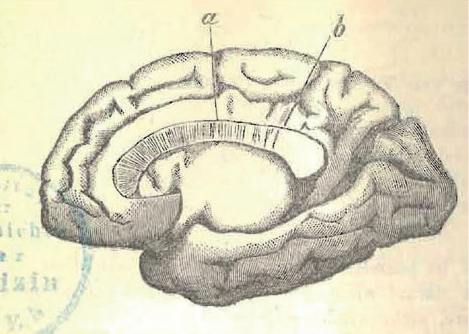
Identification of ‘motor’ zone by Betz from his first publication on giant pyramidal cells of the cortex, translated into German and published as ‘Anatomischer Nachweis zweier Gehirncentra’ in the journal, Centralblatt fu¨ r die medizinischen Wissenschaften in 1874 (Betz, 1874).
Atlas of Human Brain published by Betz in 1890. When the administration at St Vladimir University saw the quality of the book, Betz received some financial support for further publications.
At that time, the scientist again suspended his work on publishing the atlas. He wanted to complement the ready 30 tables with new, clearly reflecting the results of these studies. But unfortunately, the study that took so many years of dedicated work, effort and talent, was never published. Only one printed copy of the Atlas (“Atlas of the Human Brain by the Professor of St. Volodymyr University V.O. Betz”, 1860-1890) is known and is now stored at the Department of Anatomy of the O. Bohomolets National Medical University in Kyiv. So, all the difficulties and obstacles in preparing this atlas, desperately overcome by Volodymyr Betz,
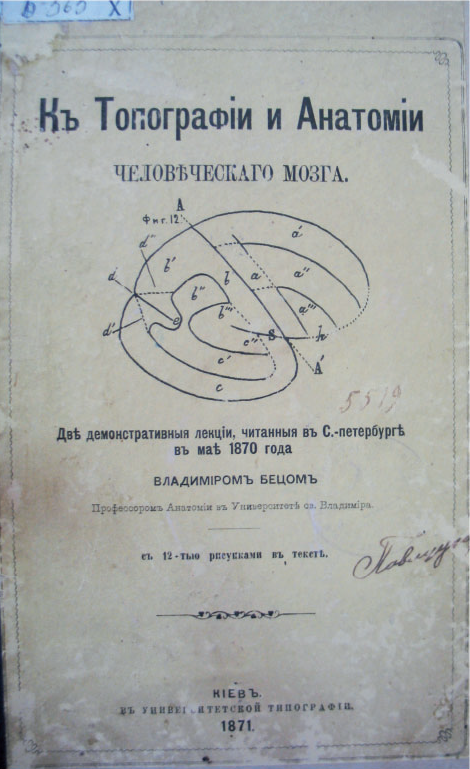
Betz lectures published as a book: On Topography and Anatomy of the Human Brain – Two demonstrative lectures given in St-Petersburg in May 1870 (Betz, 1871).
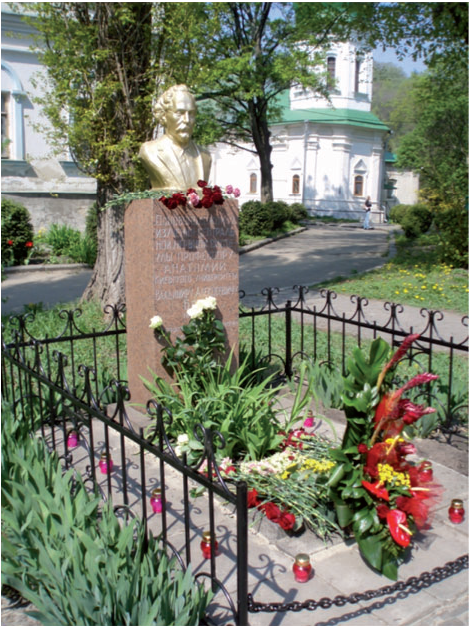
The grave of Betz in Kiev at the Vidubicheskiy Monastery (built in A.D. 1077) adjacent to the west bank of the Dnieper river. The panoramas from the grave and monastery befit the scientific vision of Vladimir Betz. According to Ukrainian tradition, to be buried in a monastery is to have achieved a life of service and honour for humanity.
Apparently, without them we could not talk about Betz as one of the prominent activists of photography and even printing in Kyiv, the founder of the first Kyiv phototypesetting lab. Volodymyr Betz participated directly in the opening of the photographic section at the Kyiv department of the Imperator’s Russian Technical Society and headed it for a long time. At the 4th regular meeting of the Kyiv Society of Naturalists on April 24, 1882, V. Betz made a report about momentary photographic methods. He studied, organized and technically equipped the photolab and typography at such a high professional and qualitative rate that received orders, including from abroad, for manufacturing clichés and printing illustrated books. Actually, speaking of Volodymyr Betz’s publishing activity, we should stress that he participated actively in publication not only of biomedical issues, but also of works on history, ethnography, archeology. A special place among the works published by Volodymyr Betz takes a book written jointly with Ukrainian historian Volodymyr Antonovich, "Historical Figures of the South-West Russia in Biographies and Portraits." This book was aimed to familiarize a broad audience with the biographies of prominent Ukrainian figures, especially Hetmans. The basis of the illustrated material was made of portraits from the collection of a renowned collector of Ukrainian antiquities, V.V. Tarnovsky. The publication of this book could not appeal to the imperial Russian authorities that ruled Kyiv at that time. Volodymyr Betz was accused of "Malorossian separatism" and eventually dismissed from the post of the Head of department. The fact that Volodymyr took a direct part in publishing of this project does not seem strange. His interest in history can be clearly seen even in purely biological papers and lectures, in which he had always paid much attention to the historical aspect. Betz’s passion for Ukraine's past was also contributed to the fact that he belonged to the descendants of the Cossack officers of Hetman age, among which the memory of a glorious past cherished. Volodymyr died on October 12, 1894 (Sept. 30 Old Style), at 4 o'clock in the morning. But before, he also was periodically ill. Frequent catarrhal diseases might be contributed to the fact that it was always cold in the Anatomical Theater: Betz even had to put a fur coat on his shoulders while lecturing. The tomb of the great scientist is located in the picturesque and secluded corner of Vydubychi Monastery in a few steps from the Church of Archangel Michael – it was the last will of Betz.
REFERENCES:
1.Назаренко, Д. ( 2012) Володимир Бец: у медицині й поза нею. Скарбниця української культури. Збірник наукових праць.– Вип. 14. Чернігівський історичний музей імені В. В. Тарновського, Чернігівське відділення Інституту української археографії та джерелознавства імені М. С. Грушевського НАН України, Чернігівська обласна організація Національної спілки краєзнавців України; – Чернігів – 251-27.
2. Kushchayev, Sergiy V., et al. "The discovery of the pyramidal neurons: Vladimir Betz and a new era of neuroscience." Brain 135.1 (2012): 285-300.
3. http://anatom.ua/memoria/betz/
4. http://www.nmu.edu.ua/eng/kaf7-1.php
5. Moskalenko, V. F., Cherkasov, V. G., & Vasilenko, D. A. (2010). The world-renowned Ukrainian neuroanatomist Prof. Vladimir A. Bets. Neurophysiology, 42, 3-9. http://link.springer.com/article/10.1007%2Fs11062-010-9124-x